Jack Kirby told us the origin of Captain America three times. First in 1941, when Cap was introduced to the world. Weakling Steve Rogers was injected with the super soldier serum by Dr. Reinstein, transforming into our hero. When Cap was reintroduced to the world via the Marvel Universe in Avengers #4, Kirby needed to remind everyone of how he came to be. So, shortly after he was given his own shared space in Tales of Suspense, Kirby once again told Cap’s origin. In Tales of Suspense 63 Kirby uses one five panel page to show the scene. We see frail Steve Rogers drink the super soldier serum handed to him by Dr. Erskine. Why drink versus injection? The Comics Code Authority. It was essentially forbidden to show someone getting an injection. The actual transformation happens over three panels, the first of which is the reaction shots of those watching it all happen. Why Erskine from Reinstein? I have my theories, but I can’t find anything that definitively tells us why.
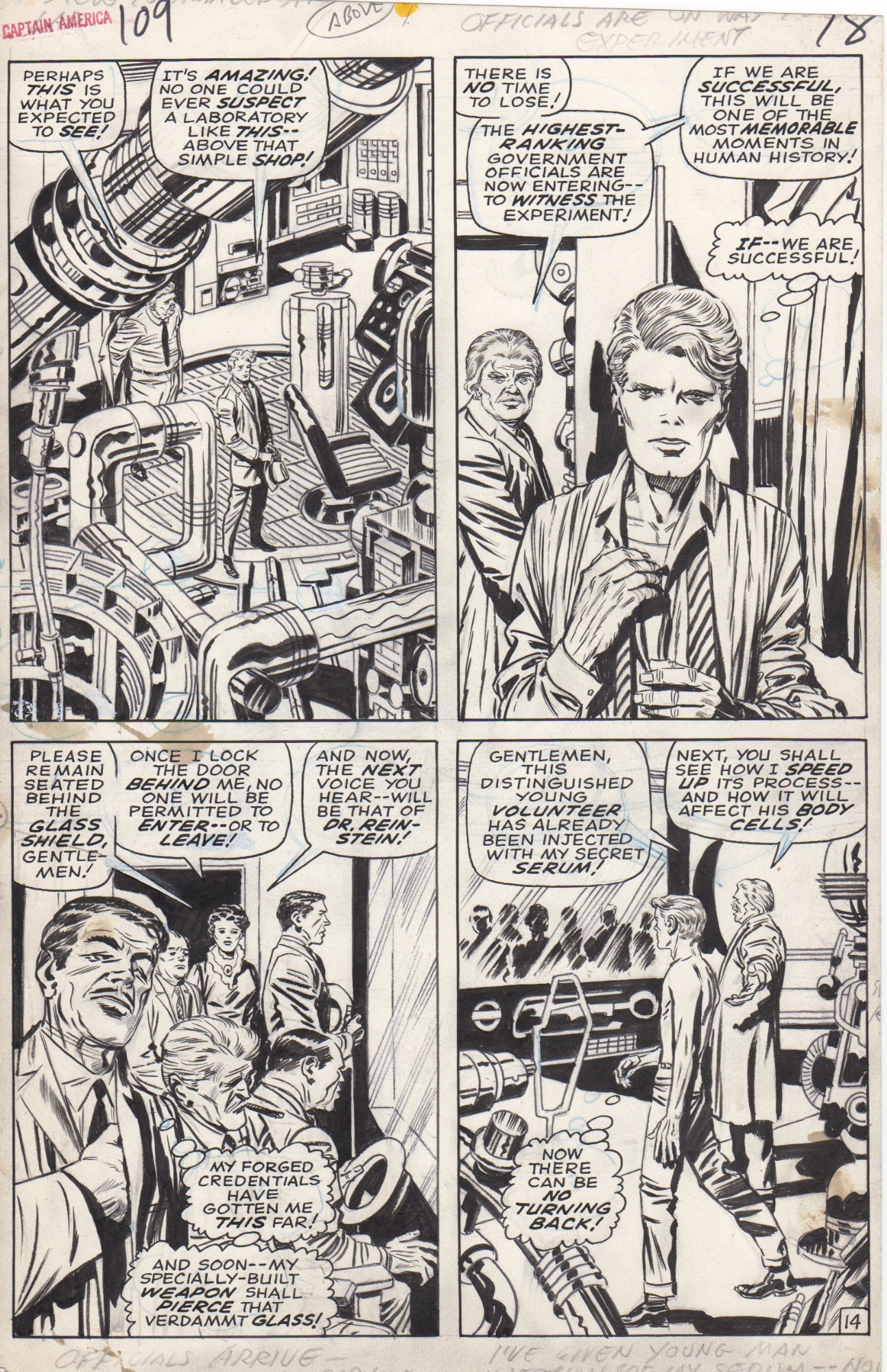
But, a few years later, with Cap now in his own book, Kirby decides to once again tell the tale. But, now, Kirby is at the peak of his powers and the Marvel Universe is no longer a fledgling title, it’s a full bore powerhouse. In Captain America 109, Kirby changes the origin one more time. This time, to fully put Cap in the same style as many of the star Marvel line up, he adds the missing ingredient. Radiation. The Fantastic Four, Spider-Man, the Hulk, and the X-Men (sort of) owe their powers to radiation. It was time to add Cap to the list.
In Cap 109, skinny Steve Rogers undresses and prepares for the experiment on page 14. Interestingly, Kirby has him injected with the serum (but off screen). Then, on page 15, he is bombarded with the Vita-Rays and we watch him painfully transform over the next four panels, enduring some significant Kirby Krackle before emerging as the Super Soldier. The Vita-Rays have stood the test of time, including being part of the Marvel film universe.
These two pages were exhibited as part of The Art of the Superhero exhibit at the Jordan Schnitzer Museum of Art in 2009/2010, and the subject of a great essay by Charles Hatfield.
I first saw these pages in the Hakes auction in 2014. I planned and was still caught off guard when the price sailed over my limit. So, when they came up again in the Heritage auction earlier this year, I was ready. There was a lot of chatter on the message boards about the price paid for two small art Captain America pages with no Captain America in costume. But, I was thrilled to pick these up. They are historic, not only for what they mean for the character of Captain America, but for showing how Kirby had evolved and setting the stage for future graphic storytelling.
Besides, it’s the Vita-Rays!!!!!