As I’ve mentioned in past posts, I’m fond of the DC War Comics. For a hobby so closely tied to nostalgia, war comics are about as nostalgic as it gets for me. My grandfather would read western and war comics, and there was always a stack in his apartment in Budlong Woods on the North Side of Chicago. He maintained it was to help his English, I just think he liked comics. To me, the war comics always were a touch more exciting than most other books because even though I was pretty sure Rock was coming back for the next issue, everyone else seemed to be at risk. For a while, I think the life expectancy of a new character in a book with Sgt Rock could not have been any greater than anyone wearing a red shirt on an away team mission in “Star Trek”.
Mostly written or edited by Robert Kanigher, the war comics were not simply shoot ‘em ups. Many of the books had a deeper morality story. Sure, it was good versus evil. Us against the Nazis. But, many of the stories had much more than that going on. Heroism sometimes comes from where you least expect it. War isn’t glamorous, and not all evil is evil. Sometimes good people die, and sometimes, the bad guys win. In these stories, interpersonal relationships were pretty well developed between the covers, and not all of the action involved bullets flying. Now, there were certainly many EC war related stories, but post Comic Code Authority, DC was the place to be for War books.
Our Army at War, which started in the 50’s, and became Sgt. Rock with issue #302 in 1977, was one of the key war titles. But, there was the G.I. Combat, Unknown Soldier, Our Fighting Forces, the Losers, and, of course, Enemy Ace. Arguably the most famous character from this genre was Sgt. Rock. He made an earlier appearance in G.I. Combat, and the character appeared in some form in issue #81. But, the first full appearance of Sgt. Rock was in Our Army at War #83. The artist most closely tied to these books? Joe Kubert. Although, there were other artists before Kubert and also during the run, Kubert was the man most closely tied to Rock.
Joe Kubert started working in comics long before the 60’s. In fact, there are stories that he started working in comics when he was 12 years old in 1938! But, since I wasn’t around till then, I didn’t notice all of that work! I’ve been able to pick up a few of his war comic pieces. I think Joe’s first issue of Our Army at War was #32 in 1955. If you’re a fan, I also just picked up “The Art of Joe Kubert” by Bill Schelly at SDCC. It’s really an interesting book and focuses on his artwork by decade. Most of the photos are of comic pages, versus original art, so that’s disappointing, but it’s still a good read. I’ve been told that DC is working on a book of his artwork which will use scans of OA, and I can’t wait! I’ve been told that Joe has kept much of his artwork, so I’m hoping that the rumor of the book is true.
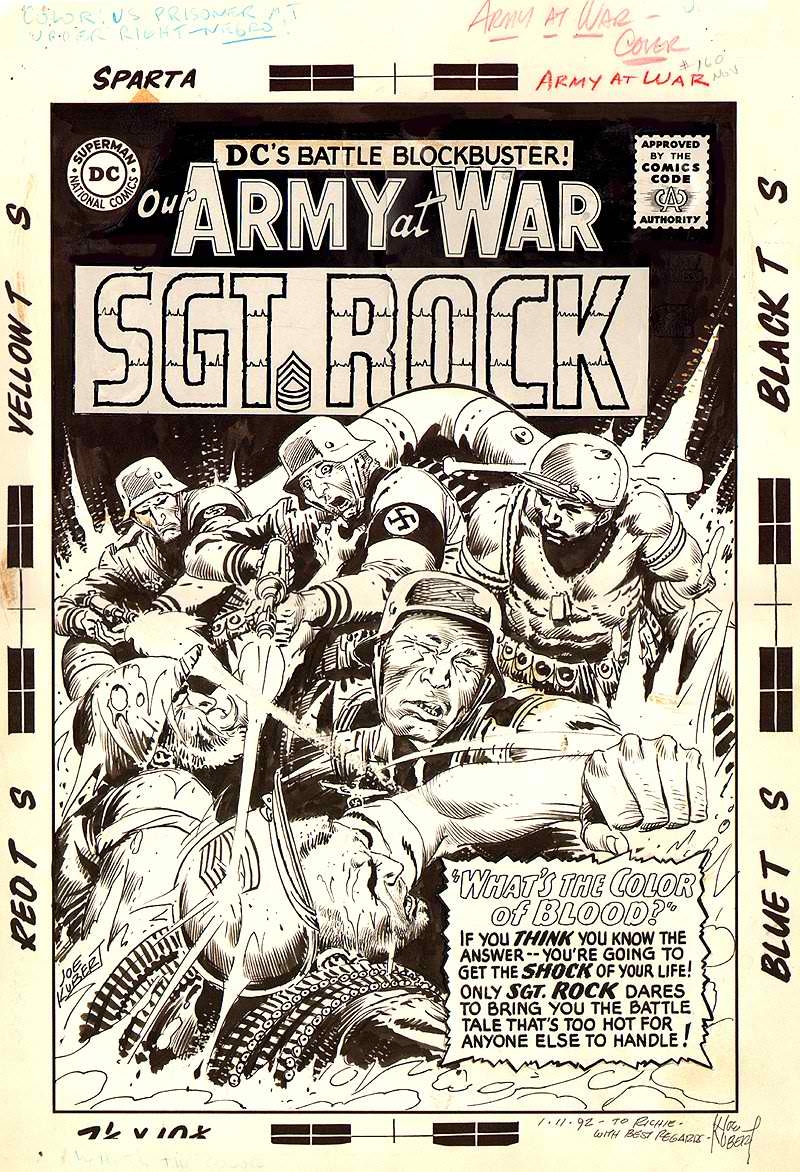
Anyway, when the opportunity to pick up a twice up cover from Our Army at War floated by, I jumped at the chance - especially for this story. As I mentioned above, the war books were often morality plays. One of the most interesting was #160, “The Color of Blood”. In this story, Rock’s squad has to eventually save a Nazi with a blood transfusion. The only correct donor? Jackie Johnson, who is black. Now, I’m not totally fact based on this, but by 1965 (when this was published), the number of black characters in DC comics were small, and the number of those on a cover? Really small. So small, that Joe had to write a note to the colorist in the upper right hand corner reminding him to not miss that point. Remember, the Civil Rights Act was enacted into law in 1964, and the Comics Code authority was a little behind the times.
Anyway, for your perusing pleasure, I present the cover to Our Army at War #160 from 1965 in all of its twice up goodness. Enjoy!