Returning to the city, Martin and Renate discuss the challenge of identifying a woman seen in a photograph of Prince Rudolf's household:
“Munich.”
“A really nice apartment, Renate. My compliments, did you design it by any chance?”
“Well, I certainly couldn't leave the task to someone else. Architecture is my passion, as well as my job. That's why when I come across structures like the Eagle's Nest, I am fascinated by them, even if I have to force myself to separate it from the aberrant ideology that produced it.”
“I understand.”
“Adolf Hitler was a failed artist, as you know.”
“It's true, Java. Twice the Fuhrer failed the entrance exam for the Academy of Fine Arts in Venice.”
“If I’m not mistaken, they told him that his landscape style was devoid of artistic value, and invited him to apply to the school of architecture.”
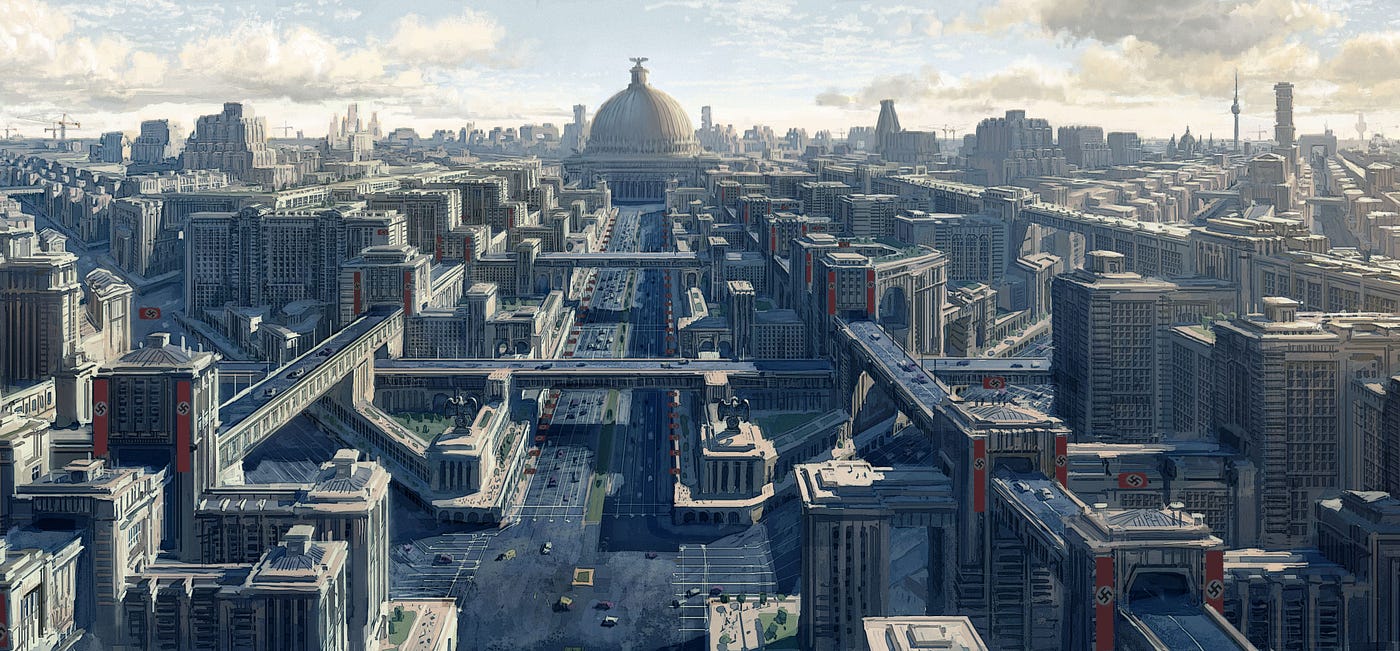
“Exactly. Which he never did. Years later, together with Albert Speer, the chief architect of the Nazi party, he supervised several projects, the craziest, most ambitious of which was ‘Germania’, the great capital of the Third Reich that was supposed to rise from the ashes of war-torn Berlin.”
“Fortunately, almost none of their projects ever came to fruition.”
“Do you think that the tunnels inside the Kehlstein mountain were also conceived by Hitler?”
“It’s possible. He used to make sketches that Speer then made concrete.”
“Back to us. I tried to do some research, but there are no lists of the servants at Mayerling.”
The middle tier of page 31 holds an image of Hitler's proposed model city. Sforza got as far as laying it out in pencil (quite nicely) but then switched gears, since the published panel contains a scanned image of a painting which is impressive but impractical, with roads on bridges between buildings, hundreds of feet in the air.
Likewise the first tier on page 30 contained a photograph of Munich as an establishing shot, instead of a drawing.